Introduction
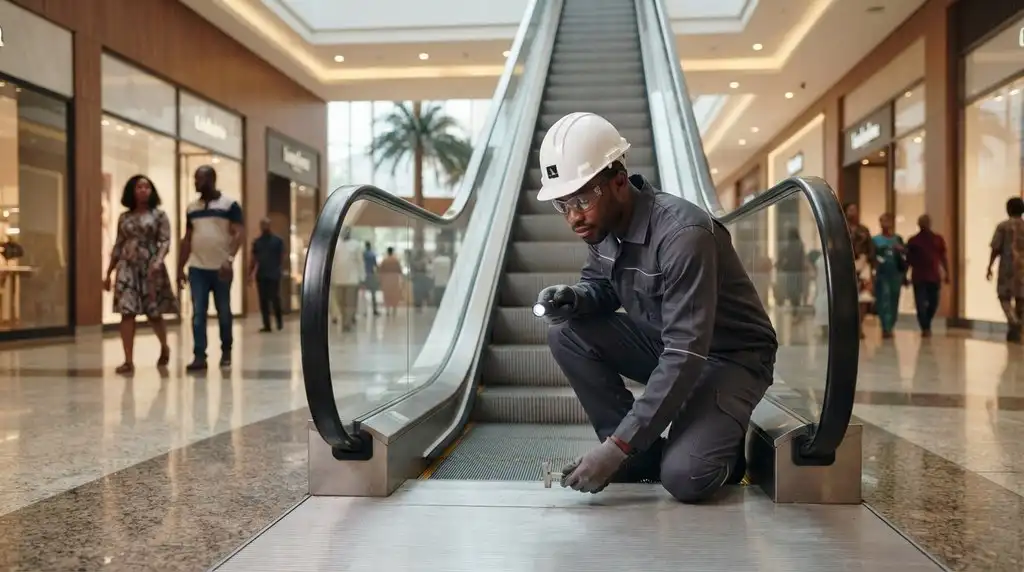
A shopping mall escalator runs twelve to sixteen hours a day, every day. By the end of its first year, it has completed millions of step cycles. That is the equivalent of a passenger lift making trips for a decade.
Most Lagos mall operators understand this intellectually. Fewer budget for it properly. Escalators are usually treated as a fixed asset with a warranty, not as machinery with a maintenance curve. Then year three arrives, the step chain starts skipping, a handrail fails mid‑morning, and the mall is running on one escalator per level during peak trading.
This guide explains what escalator maintenance actually involves in Lagos conditions, what drives the recurring cost, and how to structure a budget that prevents unplanned shutdowns.
Hard fact: Escalators in Nigeria must comply with EN 115‑1, and SON requires periodic verification. A failed inspection can result in the escalator being shut down until remedial works are completed — with no trading exemption.
What Routine Escalator Maintenance Actually Covers
Escalator maintenance is not a monthly wipe‑down. It is a structured programme across several mechanical and electrical systems, each with its own wear pattern.
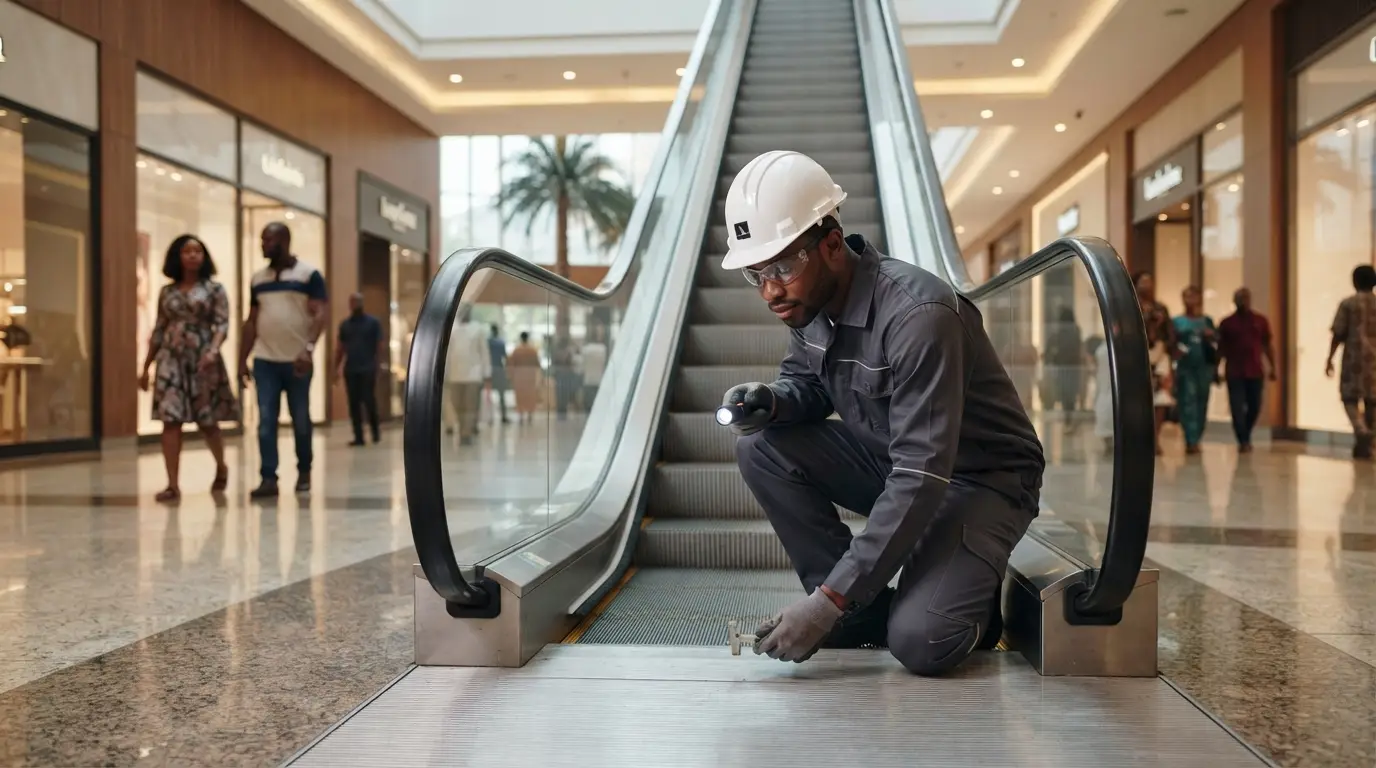
Step chain and step band. The step chain carries the entire load of the escalator. It runs on the drive sprockets and is tensioned by the tension carriage. Over time it elongates, causing steps to ride unevenly, generating noise and eventually jumping the sprocket. Tension adjustment and elongation measurement are part of every service visit.
Handrails. The handrail must move at the same speed as the steps — within a tight tolerance set by EN 115‑1. Handrail drive belts, rollers, and the handrail itself wear. A stretched or cracked handrail is a safety issue and a common cause of escalator shutdown.
Comb plates and skirt brushes. The comb plate at each landing is where debris collects — sand, grit, coins, and bag fragments. Damaged comb teeth or missing skirt brush segments create gap hazards that are a leading cause of escalator injuries. These require frequent inspection, particularly in Lagos where dust ingress is high.
Brake system. Escalator brakes are the last line of defence if the drive fails. Brake lining wear, release clearance, and stopping distance all require scheduled checking.
Drive, controller, and safety devices. The controller monitors step speed, handrail speed, comb plate intrusion, and skirt panel deflection. Safety switches must be tested for correct operation. Loose or corroded terminals cause false faults — especially in humid conditions.
Hard fact: The two most common causes of escalator injury internationally are comb plate entrapment and skirt panel gap hazards. Both are prevented entirely by scheduled inspection and replacement of low‑cost components.
Bridge: Lagos conditions accelerate wear on almost every one of these systems.
Why Lagos Conditions Drive Up Maintenance Costs
Escalator maintenance in Lagos is more demanding than in temperate cities. Three factors drive this.
Humidity and salt air. Lagos coastal humidity accelerates corrosion on step chains, handrail guides, and electrical contacts. Coastal malls in Victoria Island and Lekki see faster degradation than inland malls in Ikeja. Stainless steel components and sealed enclosures reduce the problem but do not eliminate it.
Dust and grit. Lagos dust infiltrates step bands, comb plates, and skirt gaps. Grit acts as an abrasive between steps and the skirt panel, wearing both surfaces. Malls near busy roads or construction sites experience this more severely.
Footfall concentration. A busy Lagos mall can carry far higher peak footfall than the escalator's original design assumption. Heavy footfall accelerates step chain elongation, handrail wear, and step roller degradation. Running escalators with auto‑sleep sensors helps, but the trading hours mean high cycle counts regardless.
Unreliable power. Voltage fluctuations stress the drive and controller. Without proper surge protection at the escalator panel, controllers develop intermittent faults that are difficult to diagnose and expensive to repair.
Hard fact: An escalator on the Lagos coast typically reaches step chain replacement age sooner than an equivalent unit in a temperate city. This is not a manufacturer defect — it is a direct consequence of humidity, salinity, and heavy duty cycles.
For comparison on how the same environmental factors affect lifts, see our breakdown of MRL elevator maintenance problems in Nigeria.
Bridge: Understanding what wears is one thing. Structuring the budget is another.
What Drives the Escalator Maintenance Budget
We do not publish fixed maintenance figures, because an escalator contract is built around the specific asset. What we can do is explain the variables that determine your recurring cost.
Number of escalators. A mall with eight escalators is a different maintenance scale from one with two. Each unit needs its own scheduled visits and its own spare parts reserve.
Rise and truss length. A longer escalator has a longer step chain, more steps, more guide rollers, and a bigger drive. Component replacement costs scale with size.
Duty cycle. Escalators running continuously through twelve‑hour trading days wear faster than units with auto‑sleep and variable speed modes. Higher duty cycle means more frequent service visits and shorter component life.
Age of the installation. New escalators need scheduled servicing. Older escalators need scheduled servicing plus planned component replacement — step chains, handrails, drive components, and increasingly, controllers.
Service model. A breakdown‑only arrangement costs less monthly but leaves you exposed when something fails. A full preventive contract costs more predictably and prevents most unplanned shutdowns.
Spare parts availability. This is the single biggest cost variable in Nigeria. If your escalator brand has no local stock, a handrail or step chain failure means weeks of downtime waiting for an overseas shipment. Locally stocked brands recover in days.
Hard fact: An escalator out of service for three weeks during peak trading season is a commercial loss, not just a maintenance cost. Mall management should treat downtime as part of the total maintenance calculation.
Bridge: The practical question for most operators is how to structure the contract itself.
Preventive vs Breakdown-Only: Which Contract Structure Works
Both models exist in the Nigerian market, and both have a place.
Breakdown‑only. You call a technician when the escalator stops. Monthly cost is low. But response time is variable, parts are charged separately, and every breakdown is a commercial event. This model suits very low‑traffic escalators that rarely run — for example, in a small office building with occasional public use.
Preventive maintenance contract. Scheduled visits at fixed intervals — typically monthly for high‑traffic retail, quarterly for lighter duty. Includes inspection, lubrication, tension adjustment, safety device testing, and a written service report. Consumable parts are often included or capped. This is the standard model for malls, airports, and transit hubs.
What a preventive contract should include:
- Fixed number of scheduled visits per year, appropriate to duty cycle
- Inspection of step chain tension and elongation
- Handrail speed verification against step speed
- Comb plate and skirt brush inspection and replacement as needed
- Brake testing and adjustment
- Safety device functional testing
- Cleaning and lubrication of chains, guides, and rollers
- Written service report after every visit
- Defined emergency response time
- Access to locally stocked spare parts
Hard fact: Skirt brush segments and comb plate sections are inexpensive parts that prevent the most serious escalator injuries. A preventive contract that includes routine replacement of these consumables is not optional — it is a safety requirement under EN 115‑1.
Bridge: With the structure clear, planning the budget becomes a straightforward exercise.
How to Budget for Escalator Maintenance
A practical budget approach is to separate maintenance into three pools rather than one line item.
Pool 1: Recurring service. The scheduled visits, lubrication, adjustment, safety testing, and reporting. This is a predictable annual cost and should be budgeted as an operating expense.
Pool 2: Planned component replacement. Step chains, handrails, drive components, and step rollers have known service lives. Rather than waiting for failure, plan replacement based on cycle count and inspection data. Budgeting this annually spreads the cost instead of absorbing a large hit in one year.
Pool 3: Emergency reserve. Even with the best preventive programme, an occasional failure happens. Keep a reserve for emergency call‑outs and unplanned parts. The better your preventive programme, the smaller this pool needs to be.
What to avoid: Treating the entire maintenance requirement as a single annual figure negotiated purely on price. The cheapest contract usually means fewer visits, slower response, and parts charged at a premium when something fails. The total cost of that arrangement is usually higher than a well‑structured preventive contract.
Hard fact: Mall operators who track escalator uptime alongside maintenance spend consistently find that preventive contracts deliver higher availability at a comparable or lower total annual cost than breakdown‑only arrangements.
Bridge: One operational factor influences all three pools more than any other.
The Spare Parts Question — Why Local Stock Decides Your Downtime
This deserves its own section because it is the single biggest determinant of how long your escalator stays out of service.
Escalators are not generic. Step chains, handrails, drive sprockets, brake components, and controllers are largely brand‑ and model‑specific. When a handrail fails, you need the correct handrail for that specific escalator. There is no universal substitute.
If your brand has no local stock, the sequence looks like this: technician diagnoses the fault, order is placed overseas, shipment takes four to eight weeks, customs clearance adds one to three weeks. Your escalator is out for two to three months during peak trading.
If your brand is locally stocked, the same fault is resolved in days.
This is why we keep escalator spares in Lagos — handrails, step chain sections, comb plates, skirt brushes, brake components, and common controller parts. For malls running multiple escalators of the same model, we also offer consignment stock held on site, so the most failure‑prone components are already in the building.
Hard fact: A single handrail replacement can take a mall escalator out of service for weeks if the part is not locally available. Handrails are among the most frequently replaced escalator components and should always be held in local stock.
For the equivalent discussion on the freight side, see our guidance on freight elevator maintenance and spare parts in Ghana.
Bridge: Here are the questions mall operators ask us most often.
Frequently Asked Questions
How often should escalators be serviced in Lagos?
High‑traffic retail escalators in Lagos should be serviced monthly. Lower‑traffic units in offices or hotels can move to a quarterly schedule. Coastal malls with high humidity benefit from more frequent inspection of chains and electrical contacts.
Can we service escalators ourselves with in‑house staff?
In‑house staff can perform daily visual checks — comb plates, skirt brushes, unusual noise, handrail condition. But mechanical servicing, safety device testing, and component replacement require trained escalator technicians, and the verification must be documented for compliance.
What happens if an escalator fails during trading hours?
It should be taken out of service immediately, with barriers and signage. Operating a faulty escalator is a liability exposure and a compliance breach. Your maintenance contract should specify an emergency response time.
Do we need to replace the whole step chain when it wears?
Not always. Step chain elongation is measured, and replacement is determined by the manufacturer's tolerance. Sometimes tension adjustment and individual component replacement extend the chain's life. Eventually the full chain is replaced.
Are escalator spare parts available locally in Nigeria?
For some brands, yes. For others, no — and that determines your downtime. Before purchasing escalators, ask what local stock the supplier maintains and what the lead time is for a handrail or step chain.
How do we reduce escalator maintenance costs?
Install auto‑sleep or variable‑speed drives so escalators slow down when unoccupied. Enforce daily cleaning of comb plates and step bands. Keep the units on a preventive contract with local parts access. And choose a brand with a local support footprint before you buy.
Does SON inspect escalators in Nigeria?
Yes. Escalators fall under SON oversight and require periodic verification. Operating an uncertified escalator in a public building exposes the operator to fines and building closure.
Hard fact: Escalator maintenance records are part of the compliance evidence required during inspection. Undocumented servicing is treated as no servicing.
Planning Your Escalator Maintenance Budget?
Mall escalators are among the hardest‑working machines in your building, and they are the most visible. When one stops, every shopper notices.
We do not publish fixed maintenance rates, because a contract is built around your specific escalators — how many, how long, how heavily used, and what condition they are in. What we can do is inspect your installation, review your current service arrangements, identify the components most likely to fail, and give you a structured maintenance proposal with clear cost pools.
Running a mall, hotel, or transit facility with escalators? Contact Dove Lifts and we will assess your units and tell you exactly what your maintenance programme should cover.
👉 Speak to Dove Lifts about escalator maintenance
Dove Lifts — Escalators, moving walkways, traction and MRL lifts installed and maintained across Nigeria and West Africa. Local spare parts stock, EN 115‑1 compliant servicing, and response times you can plan around.